This BLOG proposes the establishment of a regional Maritime Institute, a major maritime professional and educational center based in an area with highway and water access to existing facilities, in particular, the extraordinary complex of maritime oceanographic activities that exist today in the Greater Tampa Bay region.
These shore-based facilities could be supplemented by a Maritime Institute Afloat, which would involve scheduling appropriate Institute activities aboard one or more vessels (seaworthy but not necessarily seagoing) acquired for the purpose, and tied up dockside as ancillary --- and relatively inexpensive --- facility space, whose bridge, deck machinery, and engine room could provide realistic equipment for instructional use in their maintenance and repair.
 Empire State VI, the training ship of the N Y State Maritime Academy
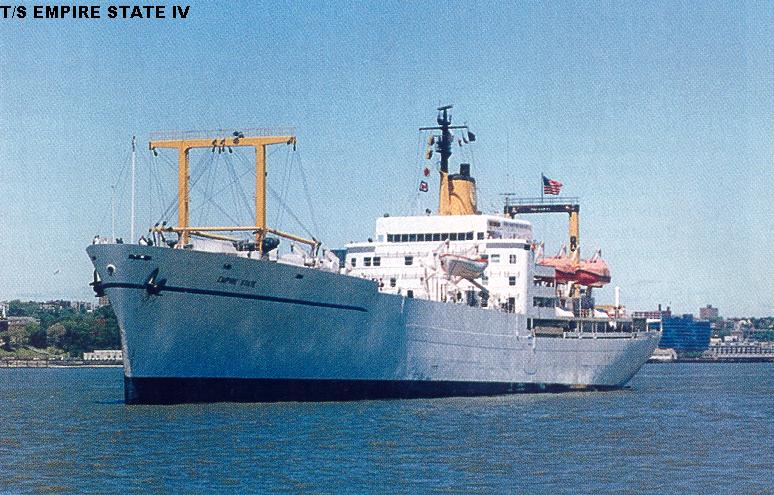 Empire State VI, the training ship of the N Y State Maritime Academy
Florida : A great place for it to head for and tie up during the very cold winter season in New York
The Institute would offer a wide spectrum of programs that meet the needs of the maritime profession, including :
The Institute would offer a wide spectrum of programs that meet the needs of the maritime profession, including :
a. Career education (what used to be called Vocational Guidance) to the region as a whole. The general population does not know or understand the critical problems facing the nation's maritime activities. Public awareness is the first step. Recruiting and guidance should take place using modern creative techniques like the Social Media to an audience with a broad demographic profile : from secondary school students all the way up through mature unemployed and (the often neglected) under-employed adults.
... and a component that encourages people to consider maritime careers that can extend far beyond traditional careers at sea, using local courses and resources already in place . For example, the University of Tampa offers courses in international trade and commerce; Stetson University's School of Law could provide courses in the fields of traditional Admiralty Law, evolving international Maritime Law and the Law of Salvage, taught by qualified, experienced instructors. The Institute could offer these courses --- modified for working mariners and professionals in the marine insurance industry, work which requires familiarity with complex technical and operational issues .
b. Professional maritime certification and upgrade programs could be made available locally -- and therefore conveniently --- at the Institute's own facilities, using portable plug-and-play courses that meet strict Coast Guard standards, and that are currently offered at other locations around the country by State and Federal maritime academies and private proprietary schools.
Courses leading to Coast Guard Certification in today’s professional maritime career field, and appropriate for a modern Maritime educational institution are outlined below .
c. Courses in international trade, the Law of Salvage, and admiralty law, designed to be easily understood by working professional mariners who don't have a legal background, yet whose daily decisions on the job must rely on a working knowledge of the legal implications of these complex fields.
d. A comprehensive understanding of Intermodal Port Operations
e. Finance, Accounting, Economics, Chartering & Brokerage, Internet and e-Commerce, Social Media Marketing, International Law of the Sea, Logistics & Supply Chain Management,Admiralty Law, and Marine Insurance are examples of other fields which help maritime-trained and -oriented students meet meaningful shore-based occupational requirements.
f. Another unusual and neglected field concerns the Geopolitics of the Circumpolar regions. Familiarity with these areas is of increasing importance given the demonstrable melting of the Polar icecap, which will make the once-fabled Northwest Passage increasingly available to intercontinental shipping between Asia and Europe.
Maritime interests have begun establishing research and shipping facilities in near-Polar areas such as Newfoundland and Nunavut, because of the discovery of vast deposits of rare metals and other critical mineral resources found under the once-neglected tundra.
Illustrative of the growing recognition accorded to northern regions by other nations is the get-together of ocean technology representatives and agents from the United Kingdom, Italy, and Spain sponsored by Canada's Department of International Trade, that was held recently in Nova Scotia and Newfoundland . The topic was Inbound European Ocean Observing, and appears to be just one of a series on ocean technology, with a priority on ocean observatories, demonstrating rapidly growing interest in the near-Arctic and the interest in Atlantic Canada as a technology Center of Excellence .
The presentations were by OceansAdvance, the new and very active organization promoting the Newfoundland and Labrador ocean technology cluster . The latter is a group of state-of-the-art marine research facilities in the Atlantic Provinces of Canada, fostering interest in forming and supporting networks at the highest level . They are encouraging technology transfer and expanded research partnerships with the newly established centers of excellence in areas of Canada that were once considered not much more than harsh and non-productive environment .
All this new focus is the result of the discoveries of vast power sources and rare earth minerals in the region, concomitant with their growing need by new high technology devices . Yet there appears to be little knowledge, recognition, understanding, or effort in the United States in developing our common interest in these resources with Canada, our closest and friendliest neighbor, outside of how it affects investment and financial exploitation for immediate profits in our security markets.
g. State-of-the-art Bridge Simulators and Engine Room Simulators, using new, improved, highly-sophisticated equipment that, like airplane simulators, teach important ship management skills while safely on the ground. These would rely on the interests and benefit from the skills that many young people have acquired through computer gaming.
h. Providing Sea Time --- on-the-water log book time required to fulfill requirements in many professional upgrades and certification
i. Vocational training in
(1) advanced welding techniques,
(2) advanced diving techniques,
(3) advanced vessel inspection techniques,
(4) port security and counter-terrorism,
(5) towing and salvage operations
(6) undersea oil and gas drill rig operations
Two years after the Deepwater Horizon accident killed 11 men and sent oil spewing into the Gulf of Mexico, the oil industry says it has learned valuable lessons from the disaster that are making drilling safer today.
But there's still a pressing issue looming for the oil industry: Oil field workers are retiring in huge numbers, leaving a workforce that's younger and — more importantly — less experienced. Dubbed "the great crew change" in the industry, the staffing challenge comes even as crews venture into places where drilling is more difficult, like the Arctic and deep below in the world's oceans .
j. Fuel Cell theory and practice --- technical understanding of these advanced technologies in power generation will be increasingly in demand given their increasing use in all applications of power generation, such as powering electrical motors directly from hydrogen, LNG, or ammonia, emitting only completely benign waste products. The theory and practice of this field are many decades ahead of the average modern mariner.
k. A Maritime Charter School --- beginning the maritime educational experience early :
Charter schools are primary or secondary schools that receive public money (and like other schools, may also receive private donations) but are not subject to some of the rules, regulations, and statutes that apply to other public schools in exchange for some type of accountability for producing certain results, which are set forth in each school's charter.Charter schools are attended by choice. While charter schools provide an alternative to other public schools, they are part of the public education system and are not allowed to charge tuition. Where enrollment in a charter school is oversubscribed, admission is frequently allocated by lottery-based admissions systems. However, the lottery is open to all students. In a 2008 survey of United States averaging 198 students.
Some charter schools provide a curriculum that specializes in a certain field—e.g., arts, mathematics, or vocational training. Others attempt to provide a better and more efficient general education than nearby public schools. Charter school students take state-mandated exams.
Some charter schools are founded by teachers, parents, or activists who feel restricted by traditional public schools. State-authorized charters (schools not chartered by local school districts) are often established by non-profit groups, universities, and some government entities. Additionally, school districts sometimes permit corporations to manage chains of charter schools. The schools themselves are still non-profit, in the same way that public schools may be managed by a for-profit corporation. Corporate management does not affect the status of a school.
In the United States, though the percentage of students educated in charter schools varies by school district, only in New Orleans are the majority of children educated within independent public charter schools.
Enabling legislation for Florida is already in place; the Governor and the current Florida state administration have indicated support; the population served : high school age youth who reject the conventional go-to-college route and are faced with an otherwise bleak future. They could be trained for a career in a field with demonstrable world-wide job opportunities at sea and ashore.
The facilities and the location would provide strong motivation; operational costs would be borne by the County school system on a per-pupil basis; higher education opportunities abound, including first rate college education at no cost at accredited 4-year service academies. The curriculum of this Charter School might be tailored to provide one or more of the following certifications, upon successful completion of the program :
(1) Certification as an Able Seaman to US Coast Guard and Maritime Administration (MARAD) standards
(2) Sea time aboard an Institute ship or other qualified vessel
(3) Commercial Marine Radio-Telephone License, Radar Endorsement
(4) Such practical certifications as fit comfortably into the curriculum, such as Basic Safety Training (First Aid, Fire Fighting, Survival); Automatic Radar Plotting Aids; Lifeboatman; Proficiency in Survival Craft; Radar Observer; and Rating Forming Part of a Navigational Watch (RFPNW)
l. USCG Certification Courses for Professional Mariners --- courses of this nature are presently available in the Tampa Bay area, BUT they appear to be, at best, modest in facilities, content, scope, and instructional resources. Top level turnkey programs are available from reputable, accredited, college level Federal and State maritime academies, courses which can be imported as plug-and-play units at the Institute. Students pay the course tuition fees; income accrues to the Institute through prior arrangements with the Academies sponsoring these programs. The Tampa Bay Maritime Institute would provide the classroom space and sponsorship.

No comments:
Post a Comment